
Currency Risk and Your Portfolio: How Exchange Rates Shape Returns
Every international investment carries a hidden variable: the exchange rate between your home currency and the asset's denomination. In 2025 and 2026, the US dollar's sharp moves rewrote returns for investors on both sides of the trade.
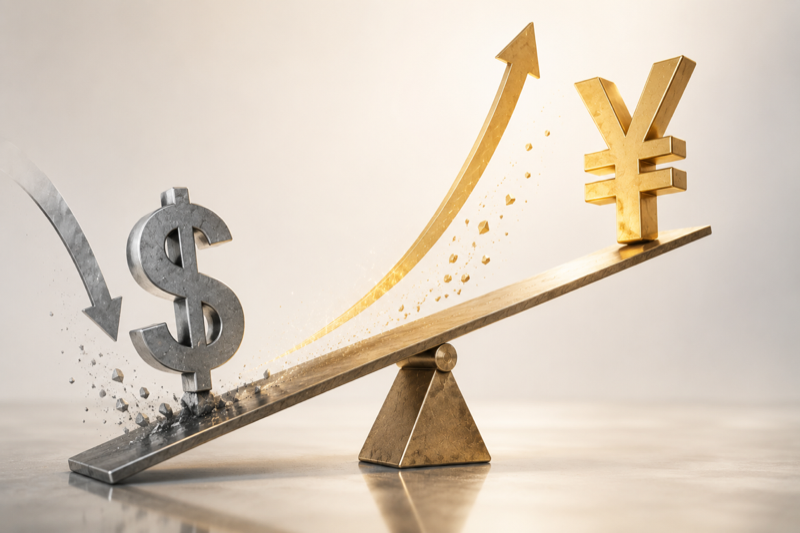
When you buy shares of a company in another country, you are making two investments simultaneously: one in the company and one in the currency it is priced in. Most investors focus on the first and give the second little thought until they convert back to their home currency and find the return looks very different from what the market delivered.
Currency risk is not exotic or technical. It is one of the most common and least discussed drivers of actual returns for any investor who holds assets beyond their home market.
A Dollar Weakness Year Rewrote Returns
The US Dollar Index fell nearly 10 percent through much of 2025, with particularly steep declines against the euro (down 13.5 percent) and the Swiss franc (down 13.9 percent). The yen fell 6.4 percent against the dollar.
For non-US investors holding US equities, this created an unfamiliar dynamic. Even as the S&P 500 delivered strong returns in dollar terms, converting those gains back to euros, francs, or yen produced significantly smaller results. A portfolio that gained 20 percent in dollar terms might have returned 8 to 12 percent in local-currency terms for a European investor.
For US investors holding international equities, the opposite applied. Foreign stocks that gained modestly in local-currency terms delivered much stronger returns in dollar terms as those currencies appreciated. This contributed to international stocks outperforming US equities on a currency-adjusted basis during stretches of 2025.
The Two Components of International Returns
When you hold an international asset, your return is the product of two factors.
The first is the return in the local currency of the asset. If you hold the S&P 500 from a European base, this is the dollar return of US stocks.
The second is the change in the exchange rate between that currency and your home currency. If the dollar strengthens 10 percent against the euro while you hold a US stock ETF, your return in euros is approximately 10 percentage points higher than the dollar return.
These two components interact multiplicatively, not additively, over multiple periods. But for practical purposes over one year, they roughly add together.
The direction of this effect depends entirely on your home currency and the direction of currency movement. Dollar weakness benefits non-dollar investors holding dollar assets. Dollar strength hurts them.
How Dollar Strength Affects Multinational Companies
Currency movements do not only affect investors. They affect the earnings of multinational corporations, which then flow through to stock prices.
For US-based multinationals, a stronger dollar compresses reported earnings. Apple, Microsoft, and other companies with 40 to 50 percent or more of revenue outside the United States routinely note in their earnings reports how much of their reported growth or decline was attributable to currency translation effects. When the dollar is strong, a company can grow its business meaningfully in international markets while reporting flat or even declining revenues in dollar terms.
Export-oriented manufacturers in other countries experience the inverse. Japanese automakers, German industrials, and semiconductor manufacturers in Taiwan benefit when their home currencies weaken against the dollar. The same dollar revenues translate into more local currency, improving margins without any operational change.
This structural reality explains why currency context appears regularly in equity research, particularly for sectors with heavy international exposure.
Understanding Currency Hedging
Currency hedging removes exchange rate variability from an international investment. The investor receives the local-currency return of the asset while the currency exposure is neutralized through forward contracts or other derivative instruments.
ETF providers offer hedged versions of most major international index products. These are often identified with an "H" in the fund name or a "hedged" designation in the prospectus. Investors who want Nasdaq-100 exposure in euro terms without dollar risk can find hedged ETFs for that purpose.
Hedging is not free. The cost reflects the interest rate differential between the two currencies involved. In 2025 and 2026, hedging from currencies with lower interest rates toward the dollar was expensive for some investors, running at several percent annually for Japanese yen hedges. Hedging from the dollar toward currencies with lower rates was cheaper or even generated a small carry benefit.
The decision to hedge depends on a view about currency direction and the cost of removing the risk. Investors with a long-term horizon who expect currency effects to average out often choose to leave international exposure unhedged. Those who want precision on asset returns or have specific liability constraints in their home currency typically prefer hedged products.
Emerging Markets and the Dollar Carry Effect
Emerging market assets are especially sensitive to dollar fluctuations because most international capital flows, commodity pricing, and debt issuance occur in dollars.
When the dollar strengthens, two negative forces hit emerging market assets simultaneously. Dollar-denominated debt carried by emerging market governments and corporations becomes more expensive to service. Capital that had moved to emerging markets seeking higher yields reverses toward dollar assets as the opportunity cost of holding non-dollar assets rises.
When the dollar weakens, the opposite dynamic often provides a tailwind. Reduced debt service burden, lower commodity prices in local-currency terms (since commodities are dollar-denominated), and returning capital flows support emerging market assets.
The 2025 dollar weakness created a broadly supportive backdrop for emerging markets. Whether this continues into 2026 depends on US monetary policy, with the May 2026 NFP data suggesting the Fed may hold rates higher for longer, which provides at least partial support for the dollar at current levels.
Currency as a Diversification Tool
Holding international assets is not only about accessing different economies. It is also about accessing different currencies, which can behave differently from your home currency in periods of stress.
For US investors, this means international developed and emerging market allocations can provide a partial hedge against dollar-specific risks. If fiscal concerns, political uncertainty, or inflation undermine the dollar's value, dollar-denominated assets lose purchasing power globally while foreign currency holdings hold it.
For non-US investors, the dollar has historically functioned as a safe-haven currency during global risk-off periods. Holding dollar assets has often provided stability when local markets and local currencies decline simultaneously.
Neither direction is guaranteed. Currency diversification reduces concentration in a single monetary system rather than eliminating volatility.
Practical Framing for Portfolio Decisions
Currency risk is always present in international investing, but it is not always the dominant driver of returns. Over long periods, equity market returns in local currency terms have generally dominated the currency effect for most country pairs.
The more practical question is whether your investment horizon and liquidity needs require you to manage currency risk actively. If you are accumulating over decades, currency fluctuations will average out substantially. If you hold international assets to meet near-term spending obligations in your home currency, unexpected currency moves create meaningful real risk.
Hedging and unhedged exposure each have appropriate applications. Understanding which situation you are in is more important than having a strong view on where any currency pair is headed.
Summary
Every international investment carries both an asset return and a currency return. In 2025, a significant dollar decline meant that non-US investors in US equities received less than the dollar return suggested, while US investors in international markets received more. Dollar strength hurts US multinationals' reported earnings and benefits export-oriented companies in other countries. Hedging removes currency risk but costs money, with that cost reflecting interest rate differentials between currency pairs. Emerging markets are most sensitive to dollar moves because of dollar-denominated debt and capital flow dynamics. Over the long term, currency effects are real but manageable if you understand which direction they cut for your specific portfolio and currency base.
- This information is not investment advice.
- Past performance does not guarantee future results.
- Backtested results are simulated and may differ from actual trading outcomes.
Kistack is an information service designed to help users review market data independently and form their own judgments. These backtests are historical simulations based on public market data and do not guarantee future investment returns. Past performance is not indicative of future results. Trading costs such as fees, taxes, and slippage are not reflected in simulations. Data is provided by Kistack; decisions are made by users.
This information is provided for educational and informational purposes only and does not constitute investment advice within the meaning of the Investment Advisers Act of 1940 (IAA) §206. Kistack is not a registered investment adviser and does not provide individualized buy or sell recommendations.
All performance figures shown are historical simulations. Disclosures regarding past performance and risk are presented in a manner intended to be fair, balanced, and not misleading, consistent with FINRA Communications Rule 2210. No statement on this site is intended to omit material facts or to mislead readers under SEC Rule 10b-5 of the Securities Exchange Act of 1934.