
US-China 2026: Trade War Fallout and What It Means for Investors
US-China tariffs hit 145 percent in 2025, then a partial truce cut rates to 30 percent in May 2026. Court rulings and supply chain rewiring across India, Vietnam, and Mexico are reshaping where global capital flows.
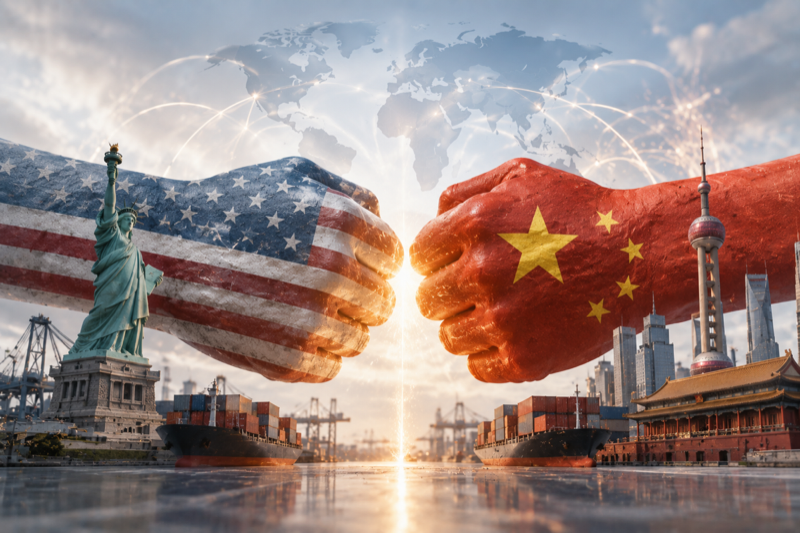
The US-China trade relationship has undergone one of the most rapid structural transformations in modern economic history. In the span of roughly eighteen months, tariffs escalated from 10 percent to 145 percent, court rulings invalidated portions of that framework, a partial truce emerged, and new legal instruments for reimposing barriers began moving through the policy process. For global investors, the question is not whether this friction will resolve cleanly. It will not. The question is how to think about a portfolio in a world where the two largest economies are operating in a state of managed, fluctuating tension.
How We Got Here: The Tariff Escalation
The current phase of US-China trade friction began in February 2025 with a 10 percent US tariff on Chinese imports. The rate escalated rapidly, reaching 145 percent by mid-2025. China responded symmetrically, imposing 125 percent tariffs on US goods.
At those levels, the trade relationship effectively collapsed on many product categories. US imports from China fell to their lowest levels since China entered the World Trade Organization in 2001. Chinese exports to the US entered a similar freefall. The bilateral trade volumes that had grown for two decades contracted dramatically within quarters.
The economic costs were concrete. American households faced an estimated 1,500 dollar annual increase in effective purchasing costs, the equivalent of a significant tax increase at the median income level. US companies that had built supply chains around Chinese manufacturing faced immediate margin compression, sourcing disruption, and multi-year restructuring costs.
The Legal Turn: Court Ruling and New Authorities
In February 2026, the US Supreme Court ruled that the Trump administration's use of the International Emergency Economic Powers Act (IEEPA) as the legal basis for broad tariff impositions was unconstitutional. The ruling removed the legal foundation for a significant portion of the tariff structure.
The administration responded by initiating new investigations under Section 301 of the Trade Act of 1974, targeting China, Vietnam, Taiwan, Mexico, Japan, and the European Union simultaneously. Section 301 is a different legal instrument with its own procedural requirements and political dimensions.
By late May 2026, both sides reached a partial truce. The US reduced tariffs on Chinese goods to 30 percent from 145 percent, while China reduced tariffs on US products to 10 percent. This de-escalation represented significant progress but did not restore the pre-2025 trade environment. The USTR simultaneously proposed 12.5 percent new tariffs on Chinese goods under forced labor-related Section 301 findings, signaling that additional levies could accumulate on top of the truce terms.
Supply Chain Rewiring
The most durable consequence of the tariff escalation is likely the acceleration of supply chain diversification away from China that had begun gradually after 2018 and moved dramatically faster from 2025 onward.
Apple is the clearest large-cap example. The company incurred roughly 900 million dollars in tariff-related costs. In response, Apple moved approximately 25 percent of global iPhone production to India. Foxconn, Apple's primary manufacturing partner, expanded capacity in Tamil Nadu and Telangana states. Vietnam became a major manufacturing site for iPads, MacBooks, and accessories.
This pattern, called China Plus One strategy in supply chain terminology, extends far beyond technology. Furniture, textiles, consumer electronics, and industrial components manufacturing has shifted toward Vietnam, Bangladesh, Indonesia, and Mexico. US imports from Mexico have increased substantially as nearshoring reduces both tariff exposure and shipping time.
Mexico benefits from the United States-Mexico-Canada Agreement, which provides tariff-free access to the US market for compliant goods. Electric vehicle production, certain electronics assembly, and aerospace manufacturing have expanded in Mexico as US manufacturers reduce China exposure.
India attracted major commitments from semiconductor, electronics, and defense manufacturing investors. The Indian government's Production Linked Incentive scheme, combined with geopolitical alignment with the US, has made India one of the primary intended destinations for supply chain diversification.
Semiconductors: The Technology Decoupling Front
The semiconductor dimension of US-China friction operates on a different timeline and at a different level of strategic intensity than the general trade dispute.
The US government has imposed export controls restricting the sale of advanced semiconductor manufacturing equipment, design software, and high-performance chips to Chinese entities. These controls target the computing technology that enables AI development, advanced military systems, and next-generation communications infrastructure. They extend to restrictions on non-US firms selling equipment with US-origin technology to China.
China has responded with significant state investment in domestic semiconductor development. SMIC, China's largest domestic foundry, has made progress at 7-nanometer processes but remains multiple generations behind TSMC and Samsung at the leading edge.
The practical effect for investors is a bifurcation of the global semiconductor market. Nvidia's ability to sell its highest-performance AI accelerators into China is constrained. The company has developed China-specific versions of its products that meet export control criteria, but the revenue impact of losing direct access to the largest potential AI market is meaningful.
TSMC, the world's most advanced chip manufacturer, faces a dilemma. It produces chips for both US technology companies and historically for Chinese customers. US pressure to limit advanced-node production for Chinese clients has progressively tightened, and TSMC has reduced its China-serving business at the frontier nodes.
The CHIPS and Science Act provides approximately 52 billion dollars in US government support for domestic semiconductor manufacturing. TSMC, Samsung, and Intel are all building or expanding US-based fabrication facilities. These investments are long-term infrastructure plays that will take years to reach production scale.
Investment Implications
For global equity investors, several structural themes emerge from the US-China dynamic.
Capital flows have moved toward supply chain diversification beneficiaries. India-focused ETFs and funds, Vietnam-linked manufacturing exposure, and Mexican industrial real estate and nearshoring beneficiaries have all attracted significant investment based on this structural thesis.
Semiconductor companies with US-aligned supply chains face a political tailwind in the form of government subsidies and preferred status. Companies with meaningful China revenue exposure face regulatory and tariff risk that requires scenario analysis.
Domestic US manufacturers who had competed against cheaper Chinese imports may benefit from reduced import competition, but only if their cost structures can absorb the adjustment period while supply chains restructure.
Luxury goods, agriculture, and entertainment sectors face ongoing risk from Chinese consumer and government retaliation. The Chinese government has demonstrated willingness to use consumer preferences and regulatory tools as trade policy instruments.
The Long View on Structural Tension
The tariff dispute is tractable. The deeper competition over technology standards, military reach, currency internationalization, and global institutional influence is not. These structural tensions will define global investment conditions for years or decades regardless of whether any particular negotiation produces a temporary reduction in tariff rates.
Investors who attempt to position around each negotiation update, court ruling, or diplomatic signal will find the task unmanageable. The more durable approach is understanding which companies in your portfolio have meaningful China revenue exposure, which have supply chains at risk of policy disruption, and which stand to benefit from the structural rewiring underway. Build that understanding into a diversified framework that does not require correctly predicting the next bilateral move.
Summary
US-China tariffs peaked at 145 percent in 2025 before a May 2026 truce reduced US rates to 30 percent. A Supreme Court ruling invalidated IEEPA-based tariffs, and new Section 301 investigations are underway. Supply chains are actively restructuring toward India, Vietnam, and Mexico, accelerating a shift that predated 2025. The semiconductor dimension involves export controls and domestic manufacturing investment that will take a decade to resolve. For investors, the relevant questions are which companies have concentrated exposure to the disruption, which benefit from the restructuring, and how to maintain a diversified allocation that does not require predicting the next bilateral development correctly. The structural US-China competition extends well beyond tariffs and will remain a portfolio risk factor for years.
- This information is not investment advice.
- Past performance does not guarantee future results.
- Backtested results are simulated and may differ from actual trading outcomes.
Kistack is an information service designed to help users review market data independently and form their own judgments. These backtests are historical simulations based on public market data and do not guarantee future investment returns. Past performance is not indicative of future results. Trading costs such as fees, taxes, and slippage are not reflected in simulations. Data is provided by Kistack; decisions are made by users.
This information is provided for educational and informational purposes only and does not constitute investment advice within the meaning of the Investment Advisers Act of 1940 (IAA) §206. Kistack is not a registered investment adviser and does not provide individualized buy or sell recommendations.
All performance figures shown are historical simulations. Disclosures regarding past performance and risk are presented in a manner intended to be fair, balanced, and not misleading, consistent with FINRA Communications Rule 2210. No statement on this site is intended to omit material facts or to mislead readers under SEC Rule 10b-5 of the Securities Exchange Act of 1934.